
Ever observed your laptop getting warm when you use it for a long duration? Now imagine thousands of computers, each far more powerful than your laptop, packed side by side and running continuously.
That is roughly what happens inside a data center.
Every calculation performed by a CPU or GPU consumes electricity. A large part of that electrical energy eventually leaves the chip as heat. And heat is something computers don’t particularly like. Too much of it can reduce performance, shorten the life of the chip and, in extreme situations, cause systems to shut down.
So, along with supplying electricity to the chips, a data center has another important job:
Getting the heat out
For decades, we have mostly done that using air cooling at the chip level. But with AI changing how powerful our computers are becoming, cooling them with air alone is getting increasingly difficult.
That’s where liquid cooling comes in.
First, how does normal data center cooling work?
Think about what happens when you’re feeling hot.
Someone switches on a fan.
Air moves over your skin, picks up some of the heat and carries it away.
Traditional data centers use a similar principle.
Fans inside servers move air across CPUs, GPUs and other electronics. The hot air produced by the servers is then moved through the data center, cooled using air-conditioning or other cooling systems and circulated again.
It works remarkably well.
The problem arises when you keep putting more computing power into the same amount of space.
AI servers can contain multiple extremely powerful GPUs packed into a single rack. More computation means more electricity being consumed within that rack, and consequently more heat being generated within a very small area.
Eventually, blowing more and more air at the equipment becomes impractical.
We need something that can carry the heat away more effectively.
And liquids are very good at doing exactly that.
So, what exactly is liquid cooling?
The idea is surprisingly simple.
Instead of relying only on air to carry heat away from computer components, a liquid is brought close to the components producing the heat.
The liquid absorbs the heat.
It then flows away from the computer, carries the heat somewhere else, releases it and returns to collect more heat.
You can think of it like the cooling system in a car.
Your car engine produces a lot of heat. Rather than trying to cool the engine simply by blowing air around it, coolant flows through the engine, absorbs the heat and carries it towards the radiator.
The radiator then releases that heat into the outside environment.
A liquid-cooled server works on broadly the same principle.
Except instead of cooling an engine, we are cooling processors performing billions or trillions of calculations.
How does liquid cooling actually work inside a data center?
Let’s follow the heat.
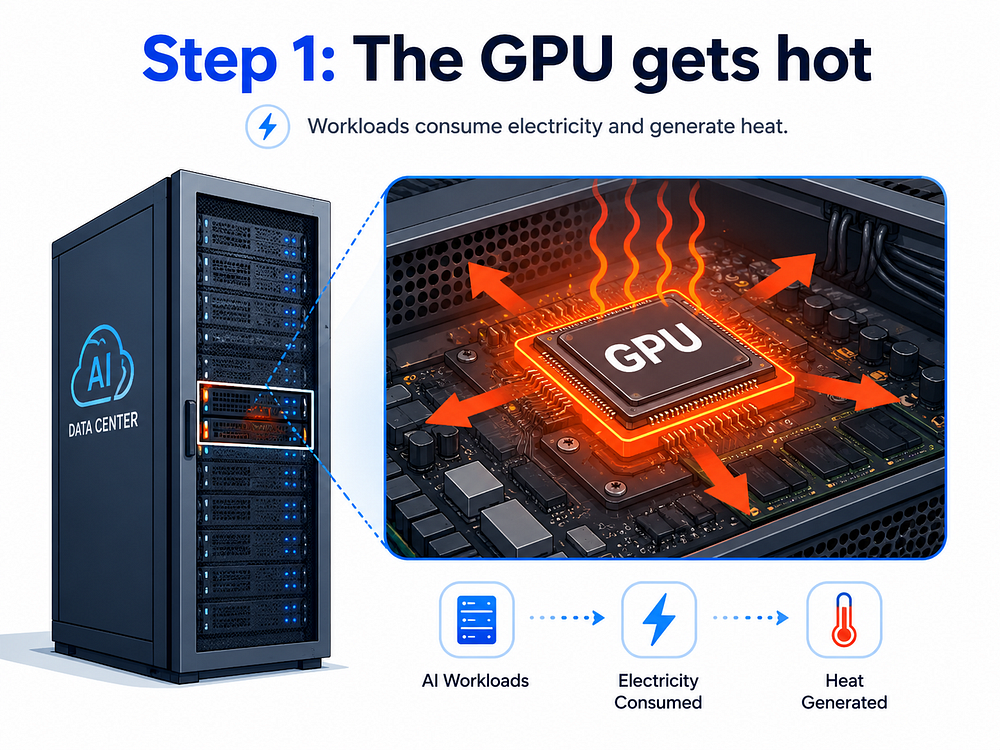
A GPU or CPU processes a workload.
The workload could be training an AI model, answering your chatbot query, processing a video or running the blog you are currently reading.
Continuous electricity flowing into the chip generates heat.
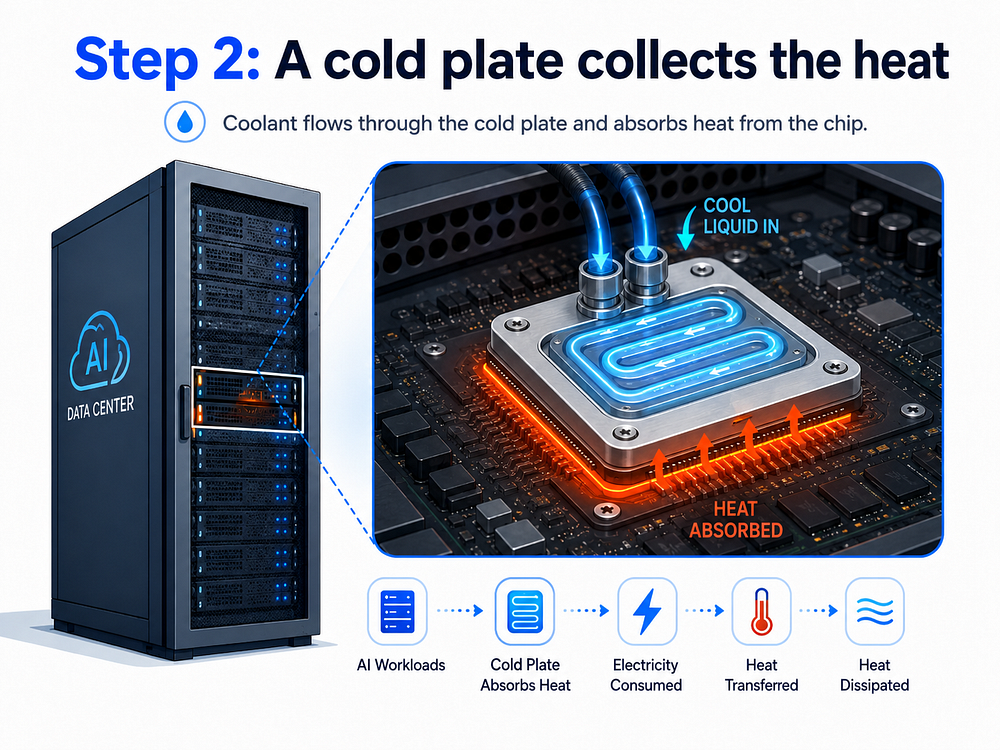
In one of the most common forms of liquid cooling, called direct-to-chip cooling, a small metal component called a cold plate sits directly on top of the CPU or GPU.
Tiny channels run through this plate, and a cooling liquid flows through those channels.
The chip heats the metal plate, and the plate transfers that heat into the liquid flowing through it. The important difference is that we aren’t waiting for the chip to heat the surrounding air.
We are collecting the heat almost directly where it is being produced.
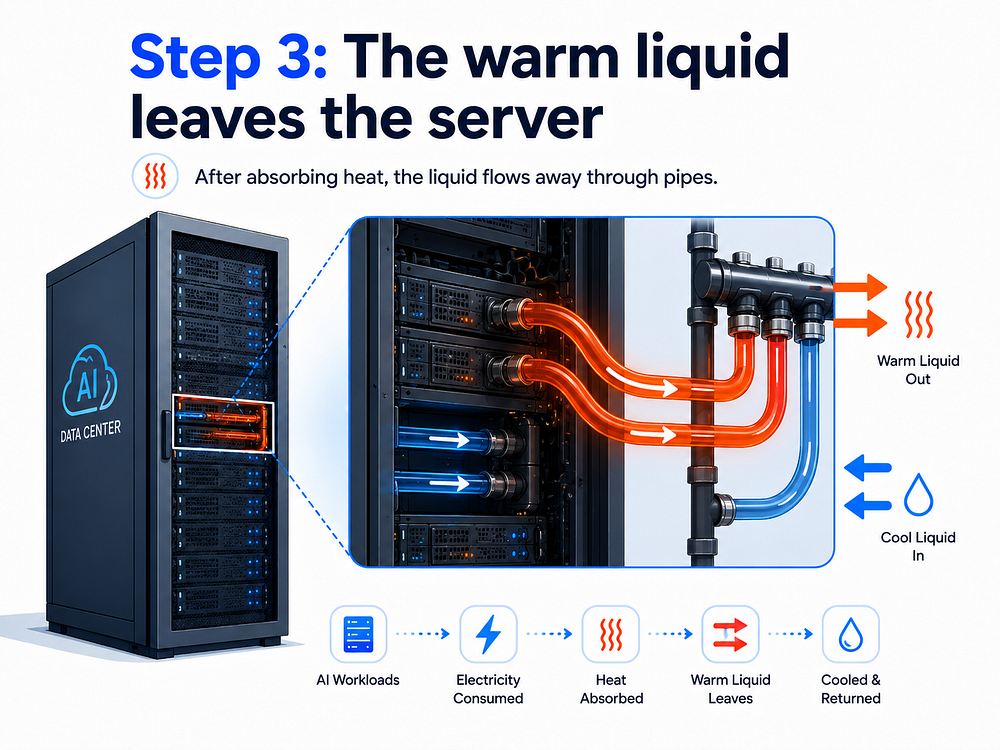
Once the liquid absorbs heat from the processors, it gets warmer. The pipes carry this warmer liquid away from the server.
Multiple servers in a rack can be connected through a network of pipes called a manifold, which collects and distributes coolant across the rack.
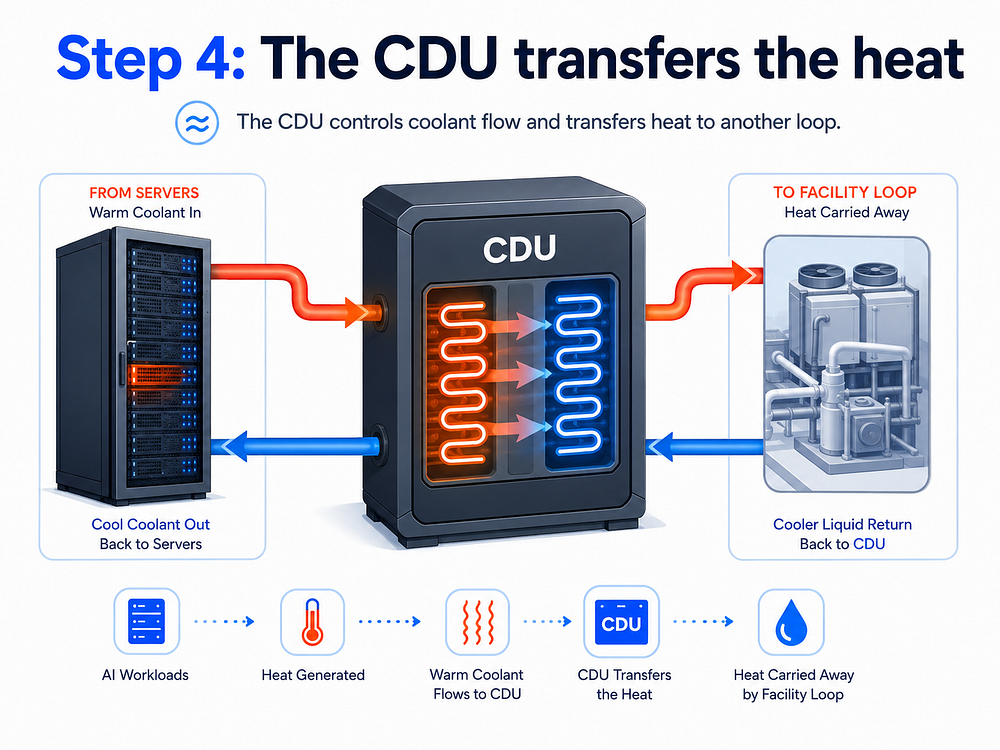
The warm coolant usually travels to equipment called a Coolant Distribution Unit, or CDU.
Think of the CDU as the traffic controller between the computers and the data center’s larger cooling infrastructure.
It helps:
- circulate coolant through the servers,
- control its flow and pressure,
- monitor temperatures, and
- transfer the heat into another cooling-water loop.
The liquids on the two sides don’t necessarily mix.
Instead, a heat exchanger allows heat to move from one liquid loop into another.
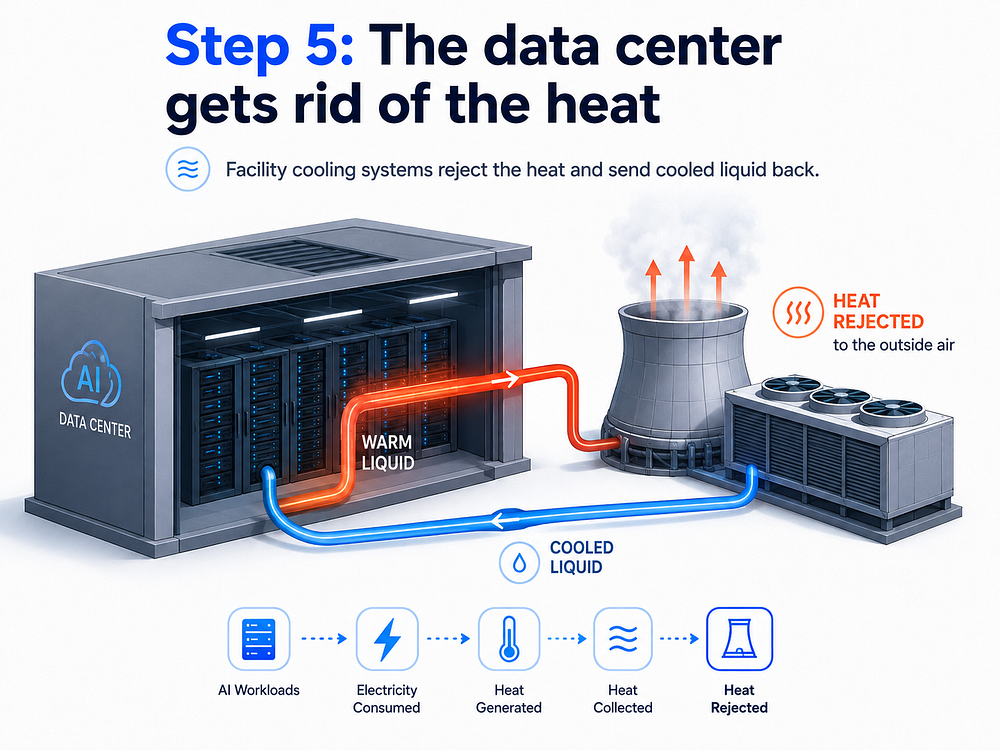
Now the heat has travelled:
Chip → Cold plate → Coolant → CDU → Facility cooling system
The data center still has to release that heat somewhere.
Depending on the facility and outside conditions, heat can eventually be rejected through equipment such as cooling towers, dry coolers or other heat-rejection systems.
The cooled liquid can then circulate back towards the servers.
And the entire process starts again.
It is essentially a continuous highway carrying heat away from the computers.
Does liquid actually touch the electronics?
This is probably the first question many of us may have.
In direct-to-chip cooling, the liquid normally flows through sealed cold plates and pipes. It doesn’t simply flow across the entire motherboard.
There is, however, another approach where computers really are placed inside liquid.
It’s called immersion cooling.
What is immersion cooling?
Imagine taking a server and lowering it into a tank filled with liquid. That’s immersion cooling.
Obviously, this isn’t ordinary water. Special dielectric fluids are used wherein the fluid doesn’t conduct electricity in the same way water does.
The electronic components can therefore operate while immersed in the liquid.
Instead of collecting heat only from CPUs or GPUs, the fluid surrounds much more of the server and absorbs heat directly from its components.
The heated fluid then transfers the heat to a heat exchanger before being cooled and reused.
Immersion cooling can be extremely effective, but it also changes how servers are installed, serviced and operated. Because of that, direct-to-chip cooling is currently becoming particularly important for large AI and high-performance computing deployments.
You may also hear about rear-door heat exchangers, where liquid circulates through a heat exchanger attached to the back of a server rack. Hot air leaving the servers passes through it and gets cooled before entering the data center.
In practice, data centers can also use combinations of these approaches.
Liquid cooling doesn’t necessarily mean every fan and air-conditioning system suddenly disappears.
A server has many components besides its CPUs and GPUs. Power supplies, memory, networking equipment and other electronics also produce heat.
So many modern designs are hybrid systems, where liquid removes most of the concentrated heat while air handles the remaining heat.
Why is everyone suddenly talking about liquid cooling?
Liquid cooling isn’t actually new. What has changed is the computer.
For a long time, a server rack might have consumed a relatively manageable amount of electricity.
AI has changed that equation.
Packing large numbers of GPUs together allows AI systems to move data quickly between processors and perform enormous calculations. But packing more processing power together also packs more electrical demand and heat into the same physical space.
But liquid cooling doesn’t make the heat disappear
It moves heat. Whether we use air or liquid, every watt of heat generated by the computing equipment ultimately has to travel through the facility and leave the data center.
Liquid cooling simply changes how we collect and transport that heat.
It is part of a broader change in how increasingly powerful data centers will have to sense, coordinate and manage energy from the workload all the way to the facility infrastructure.
And as AI keeps demanding more computing power, that relationship between compute, electricity and cooling is only going to become more important.
So, next time someone asks you about liquid cooling, hope you know what to say.